
Fleet fueling, industrial processes, and power generation all depend on firm fuel supply. When pipeline
access is unavailable, delayed, or constrained, Hydria puts compressed natural gas where operations
need it, on the operator’s timeline rather than the utility’s.
Virtual pipeline delivery | CNG battery℗ storage

Most operators already understand the economics of natural gas. The harder problem is access.
Pipeline expansion takes years, while fuel demand can shift faster than permanent infrastructure can keep up.

Pipeline access delays that stretch into years

Fuel supply that tightens in constrained or interruptible markets

Backup power and continuity requirements at critical sites

Remote operations beyond the reach of the fixed network

Scalability limits when demand outgrows the supply plan
When fuel access is the gating factor, the cost is not only higher fuel spend.
It is capacity that cannot grow and continuity that cannot be guaranteed.
Hydria combines CNG Battery℗, transport trailers, decompression, and telemetry into one delivery platform that deploys
on the operator’s timeline and scales as demand grows.
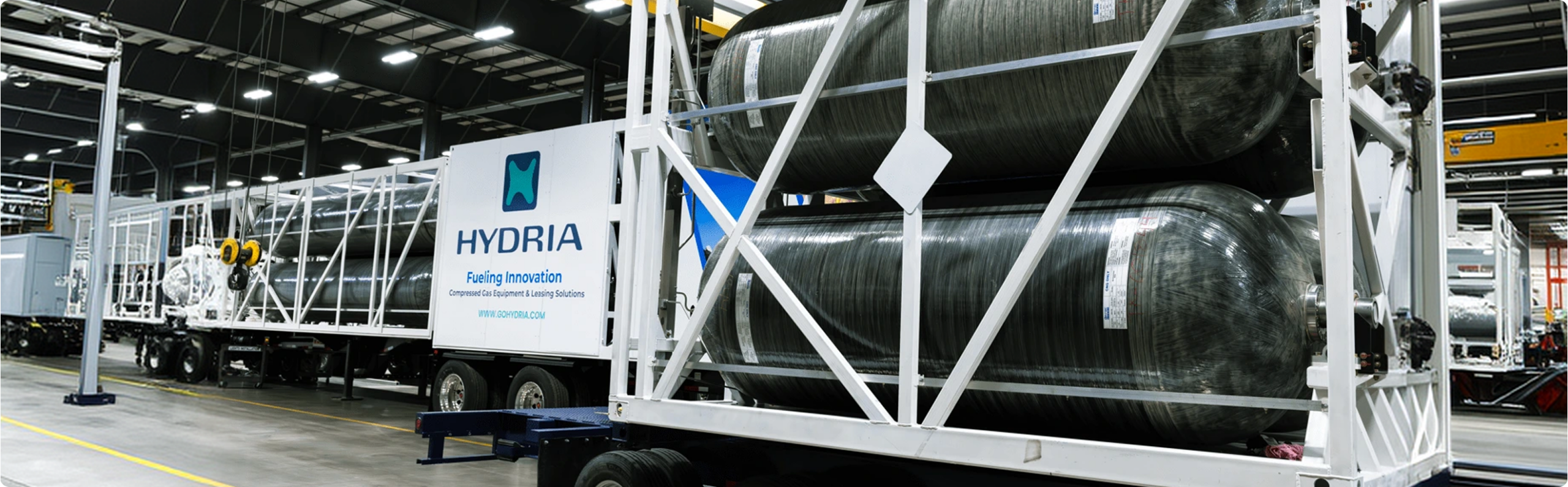
Compressed gas trailers move fuel directly to the point of use. Where a pipeline is unavailable or years out, the trailer fleet functions as the pipeline, delivering firm supply across regions without permanent construction.
Hydria Vault systems hold fuel on-site in modular configurations using the largest Type IV composite cylinders available, storing more gas in a smaller footprint with zero boil-off.
Type IV and Type II trailers move high volumes to site at up to 4,000 psi with fast-fill technology, with capacities up to 616,495 SCF so fleets
and industrial sites can match delivery to consumption.
Storage, decompression, fueling, and telemetry operate as one system, with real-time visibility into pressure, volume, and location through a secure customer portal.
A physical pipeline is the right answer when it already exists. When it doesn’t, the wait runs years and the demand is here now. A virtual pipeline closes that gap: compressed gas is loaded at a source, transported by high-pressure trailer to the point of use, held on-site in the CNG battery℗, and regulated to usable pressure, doing the work of a pipeline without the permitting, the construction, or the multi-year timeline.
What that gives an operator is control. Supply no longer depends on where the fixed network reaches or what a utility can deliver on its schedule, and fuel access deploys in modular units that scale or relocate as demand changes. A site can secure firm supply today and grow it without rebuilding.
01 Fuel Cost Savings
Fuel cost savings compared with diesel, especially in fleet fueling, backup power, and high-consumption industrial operations
02 Rapid Deployment
Rapid deployment with modular units and lower permitting hurdles, no permanent pipeline construction
03 Scalability
Scalability that grows with demand by adding or relocating storage and trailers
04 Fuel Flexibility
Fuel flexibility that supports RNG, biogas, and hydrogen blending over time
Control fuel cost against diesel and hold supply as the fleet grows, without tying expansion to fixed fueling infrastructure.
Support process energy, production continuity, and remote operations where pipeline access is limited
or absent.
Supplement gas delivery and bridge supply during constrained conditions and peak demand.
Maintain fuel availability
for backup generation, microgrids, and distributed energy, independent of grid timing.
Keep power available through interconnection delays and grid interruptions, with firm fuel supply for backup and on-site generation.
Virtual Pipeline Systems | CNG Battery℗ | Type IV Transport Trailers
Type II Transport Trailers | Decompression Systems | Integrated Fueling Solutions
Hydria solutions are engineered and manufactured in Houston. Qualifications of its gas storage and transport systems are through
US DOT, Transport Canada, and ASME certification and are backed by safety testing, telemetry, and long-term operational support.
Whether you are evaluating fleet fueling, industrial energy infrastructure, backup power, or virtual pipeline deployment, Hydria can help identify the storage, transportation, and fuel delivery strategy that fits your operation. Site assessments, cost models, and pilot projects are where most operators start.